Publication Info
Publication Details
Introduction
In the hilly country to the north-west of Alford there were originally four separate parishes: Auchindoir, Forbes, Kearn, and Tullynessle. The precise boundaries of these parishes are not recorded, but such evidence as we have puts Auchindoir to the west and Tullynessle to the east, separated by Forbes, running westward from Bridge of Alford, close to the north bank of the River Don, and Kearn, running northwards from Lumsden, and passing to the east of Rhynie. With significant populations only in the valleys bottoms, it proved impossible to fund four ministers, and a first attempt at rationalisation was made in the early 1600s, when Forbes and Kearn were briefly amalgamated. This first reorganisation seems to have failed, but was then revived in 1722. However, the underlying problem of lack of resources persisted, and a more radical solution came into effect in 1808, when the original four parishes were consolidated into just two: to the northwest, Auchindoir and Kearn, and to the southeast, Tullynessle and Forbes. As often seems to be the case with such amalgamations, while the churches of Forbes and Kearn ceased to operate, the kirkyards continued in use into the 20th century. Analysis of the placenames in the MIs suggests that folk in the former “catchment areas” of Forbes and Kearn remained faithful to the burial grounds of their ancestors. The MIs of Auchindoir (the Old and New Kirkyards, but not the modern Cemetery) were issued by ANESFHS some years ago with the catalogue code AA110. The present publication now adds the inscriptions from Forbes, Kearn and Tullynessle Kirkyards (but not the adjacent Tullynessle Cemetery, which is still in use). ANESFHS has for some time held “draft” versions of MIs from the three burial grounds. These have now been carefully revised by Allan Hepburn and Gavin Bell. Where stones have become unreadable, we have reported the earlier “draft” reading, or have quoted from historical surveys by Alexander Laing (“Donean Tourist”), Andrew Jervise (“Epitaphs and Inscriptions Vol. II”) and John A. Henderson (“Aberdeenshire Epitaphs and Inscriptions”). In addition to the three kirkyards, there are two private burial enclosures whose inscriptions are included in this publication: the Druminnor Aisle, adjacent to Kearn Kirkyard and the Whitehaugh Mausoleum in Tullynessle parish. Both are on private ground, and the Whitehaugh Mausoleum, as well as being on the “Buildings At Risk Register” is reported as being in a ruinous and dangerous condition. With the kind permission of the landowner, we have been able to view the Druminnor monuments; for Whitehaugh, we include the transcriptions as recorded by Henderson. As ever, we acknowledge Suzanne LeBlanc’s painstaking help with indexing. Gavin Bell MI Co-ordinator
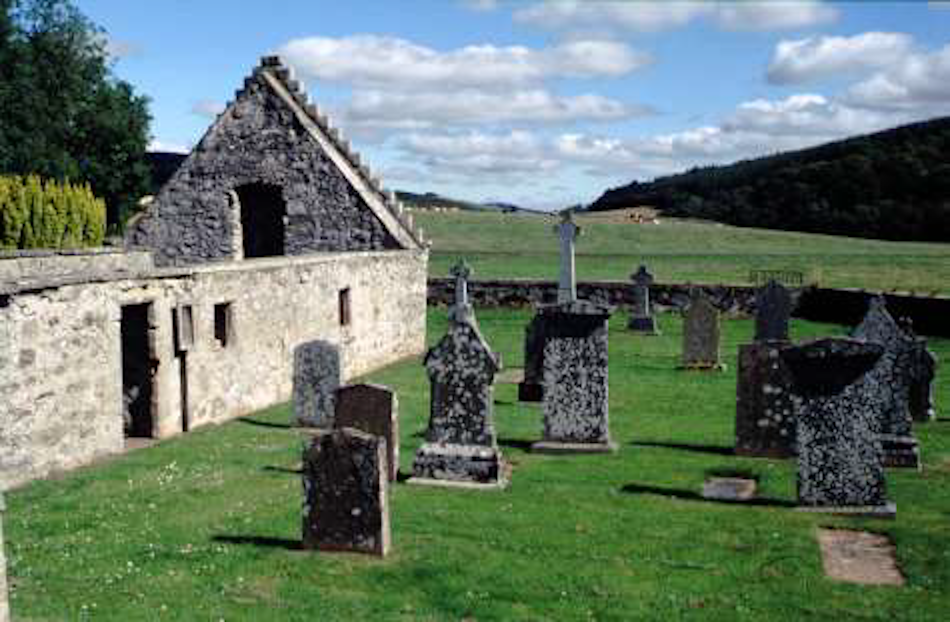
Cover Photograph by Gavin Bell