Publication Info
Publication Details
Introduction
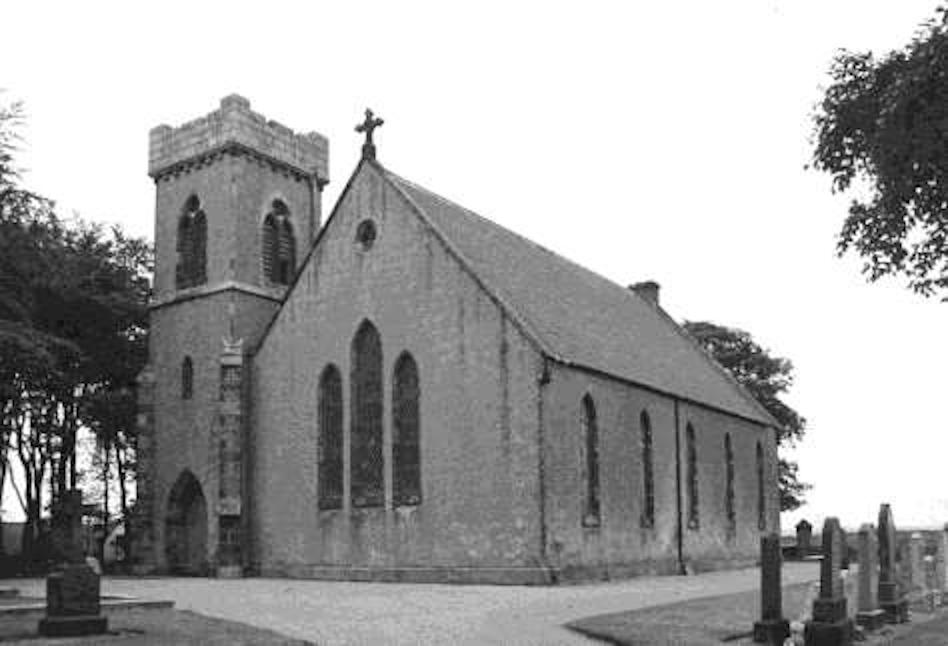
While this booklet does include a set of memorial Inscriptions, it differs from all our other MI booklets in that it sets these alongside the equivalent burial records. This might seem to be an obvious thing to do, but it is seldom possible, as access to burial records can be both complicated and expensive. So how did we manage it in this case? “Dyce United Free Church” (generally abbreviated to “Dyce UF”) is just the latest in a series of names borne, since its creation in 1869, by what was originally just “Dyce Free Church”, one of the many new congregations founded after the “The Disruption” of 1843, which saw around two-fifths of Ministers and congregations break away from the Church of Scotland. It has also, at various times, been known as “Pitmedden Church” (a nod to its important early patrons, the Thompsons of Pitmedden, whose monument dominates the southern end of the kirkyard), and as “Dyce West Church”. The church remained in existence for just 60 years, because, like various of the 18th- and 19th-century breakaways, the United Free Church returned to the Church of Scotland fold in 1929, the Dyce UF congregation merging with Dyce Church of Scotland. The date is significant, because it meant that Dyce UF escaped the provisions of an Act of Parliament which, in 1925, transferred the burial grounds then belonging to the Church of Scotland to the Local Authority within whose boundaries they lay. Consequently, ownership the Dyce UF burial ground and its records went, not to Aberdeenshire Council, but to Dyce Church of Scotland. The church building itself was demolished, leaving just the foundations to show where it had once stood. Since then, Dyce Parish Church has looked after the kirkyard and its burial records, which have recently been digitised and transcribed by Ken Knight, a member of the congregation, and which are now kindly made available to us by the Kirk Session. This is what allows us the unusual luxury of publishing the burial records side-by-side with the MIs. A version of the MIs of Dyce UF was published by ANESFHS in 1990, using the system of abbreviations, paraphrases and partial omissions then current, but the opportunity has now been taken to carry out a new survey and to record the full, literal, text of each stone. The burial records of Dyce UF are contained in a single large ledger, and more or less follow the standard pattern, with each burial recorded twice. Every interment was first entered in a single, continuous chronological list, but an entry was also made in a different section of the ledger with a separate page for each lair. Additional details of the deceased are split between the two sections, which were meant to be kept synchronised via the lair number. Unfortunately, this cross-referencing was not always correctly done, and because of that and various other departures from the standard procedure, a number of records are ambiguous, making it impossible to say with certainty where some individuals were buried. The numbering of the lairs is very strange, with oddities like “112¼” or “105A(iii)”, and gaps in the sequence, which omits numbers 24, 35-46, 92-96 and 132-228. The physical layout of the lairs is recorded clearly enough in the kirkyard plan, but unsurprisingly, whoever was keeping the records got confused, with lair “112¼” in the ledger appearing on the plan as “111L”, and “105A(iii)” being shown as “105½”, among other discrepancies. The plan included in this booklet shows numbers adjusted to match the entries in the ledger. One slightly surprising fact emerges from a study of the burial records. In a number of cases, it appears that ownership of a lair has been re-assigned, typically if the lair contained only the body of a single stillborn child, buried some time before. Such transfers were not recorded very neatly - generally, the name of the original owner and the associated burials were simply scored out, and the details of the new owner and burials entered on the same page. A quick comparison of the burial records and the MIs throws up some obvious discrepancies. There are 167 lairs, but only 113 gravestones. On examination, it emerges that (if we include the sad tally of un-named “stillborn” and “unbaptised” infants) there are just short of 200 deaths reported in the burial records which are not found in the MIs - but also that the MIs mention 37 individuals who do not appear in the burial records. As the old wisecrack has it: “the bones do not always match the stones.” On the following pages, the left-hand column shows the lair records, in numerical order, combining information on each individual from both sections of the Ledger. This will normally include the deceased’s name, relationship to the holder of the lair, age, and date of burial. There will generally be some indication of the place of death, although the degree of detail varies, and in a few cases, there will be an entry for the cause of death. Where a lair was successively owned by different individuals, the entries are separated by a dashed line. The right-hand column shows the inscription on any stone that stands (or was previously reported as standing) on the lair. The number against “MI” gives a cross-reference to the numbers used in the 1990 transcription, which was carried out before the existence of the lair records and plan was known, and is included to maintain compatibility with the online Index to the MIs. The kirkyard plan shows the corrected number of each lair, and indicates the presence and style of any gravestone. Three stones were noted in the burial records as having fallen. One has been re-erected (although apparently on the wrong lair!) and the other two, which were not found in the 1990 survey of the graveyard, have now been recovered and recorded. One can be reliably assigned to a lair, but the other might belong on one of two different lairs. One of the stones recorded in 1990 has become unreadable, and there are some minor stones which seem to have been moved from where they belong. Detailed notes on all these are included on the following pages. Gavin Bell MI Co-ordinator
Comments
Contains lair records and MIs