Publication Info
Publication Details
Introduction
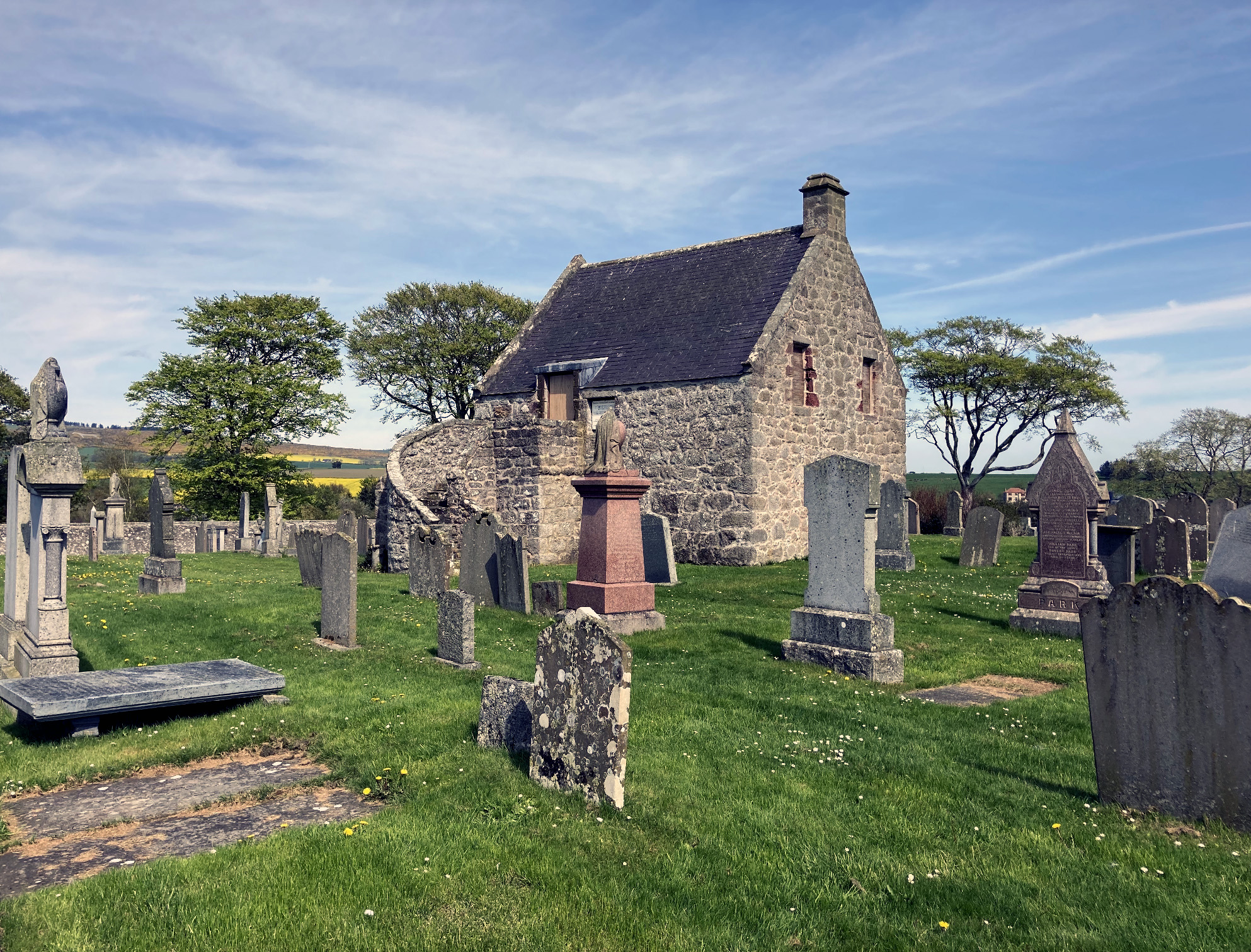
Situated off a small road just south of the North Ugie Water, the Strichen burial grounds date back to the early 17th century. Before then, since Strichen, known until 1746 as Mormond Village, was located within the parishes of Fraserburgh (Philorth) and Rathen, the local inhabitants mostly buried their dead at Rathen. In 1620, however, Thomas Fraser, proprietor of the district, built a church and family burial aisle near the river. Although the church was demolished in 1798, the burial aisle remains. While it contains no grave markers, and was even being used as a tool-shed by the 1960s, kirk session records show that several members of the Fraser family of Strichen were interred there, including the Hon. Alexander Fraser, Lord Strichen, who died at Strichen House, 15th February 1775. In 1799, a larger replacement structure, dedicated to St. Andrew, was built on the south side of the churchyard at a short distance from the old kirk, and served as a place of worship into the early 20th century. Efforts have been made to preserve the two structures: for example, in 1988, massive overgrowth was removed from the burial aisle and a new roof was installed. Nevertheless, both buildings remain empty and boarded up. Some of the existing gravestones in the Old Ground date back to the early 18th century, with one as early as 1691, but burials continued throughout the 19th century, into the 20th and even 21st, the last being in 2001. A first small extension on the northeast side of the Old Ground (but confusingly described in the Burial Records as the NW Section) appears to have come into use in the later 19th century, but most 20th century burials have been in the New Ground, adjoining the Main Ground to the southeast, which opened in the early 1900s. Burials now, however, are almost entirely within the Cemetery, a 20th century addition adjoining the Old Ground to the northwest (but which is not included in this publication). The transcripts Aberdeen And North-East Scotland Family History Society (ANESFHS) held an unpublished list of Monumental Inscriptions of the Strichen Old Kirkyard, prepared by the late Sheila Spiers, dated unknown but probably at some point during the 1980s. Although incomplete, without a map and with the MIs in the abbreviated form of the early ANESFHS MI booklets, it provided an invaluable basis for the present compilation. The present Old Ground transcript, however, is a completely revised and expanded version of the ANESFHS one. All listed MIs have been read from photographs of the individual stones, and most have been checked in person. Any MIs in the ANESFHS list that are now unreadable or are no longer found have been identified in italics. Original spellings have been retained throughout, and the inscriptions remain unabbreviated. The transcriptions of the stones in the Extension and the New Ground are almost entirely new. The numbering of the stones in the Old Ground has been revised to accommodate missing or newly-discovered stones, but still follows the original “snaking” path. The numbering of the stones in the Extension and the New Ground is based on the Burial Records, but as not every lair had a monument on it, there are gaps in the sequence. The present compilation was initiated during the autumn of 2018, at which time it was apparent that some standing stones recorded in the ANESFHS transcript had since toppled face down, and that many flat stones had disappeared beneath the turf. While photographing stones during the summer of 2021, however, our colleague Alison Butcher found that many of these buried stones had been uncovered by person(s) unknown, as well as some not previously identified (listed with an “A” after the gravestone number). Although this process was well carried out without any apparent damage to the stones apart from exposure to the elements (which, of course, was the original intent), it was apparently undertaken without official permission, and in late summer a notice from Aberdeenshire Council put an end to any further such activity. Many of the stones are now (2023) once more covered, but during the time they were visible, they were photographed, their MIs transcribed where legible and included in the present transcript. Their locations have also been added to the kirkyard plan, although in many cases, all that can now be seen is a depression or a discoloured area in the grass. A digital version of this compilation, containing photographs of the lair stones, is available in the Strichen and Fraserburgh libraries. Jim Campbell Gavin Bell