Publication Info
Publication Details
Introduction
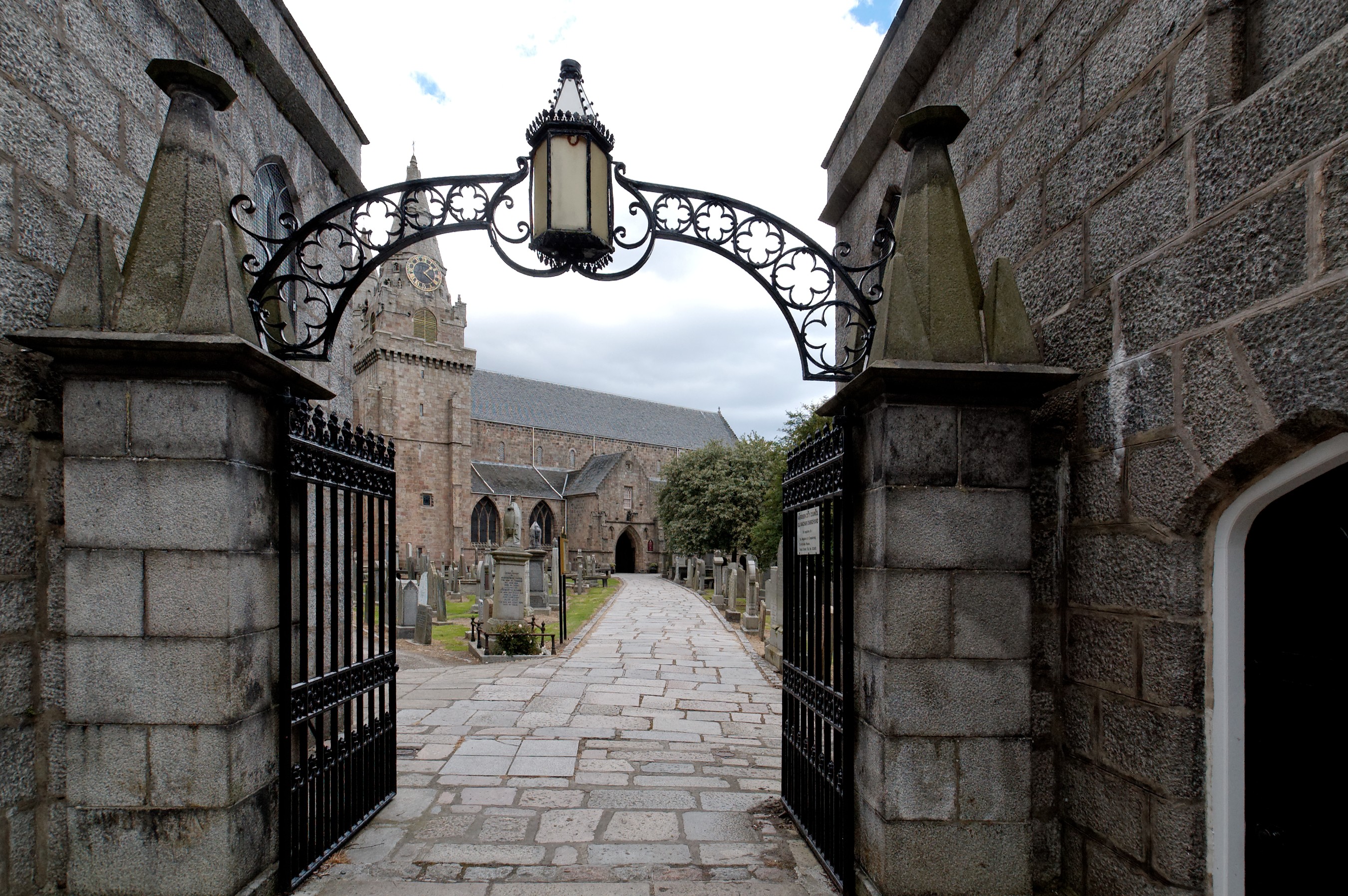
History St Machar’s is an ecclesiastical site of considerable antiquity, tradition asserting that the first church there was founded by a companion of St Columba. It was presumably a place of burial from an equally early date, but while the Cathedral houses the memorials of a few mediaeval bishops, the kirkyard today contains few monuments earlier than 1700, the great majority dating from the 19th and 20th centuries. The City of Aberdeen originally consisted of two quite separate and independent Burghs. Old Aberdeen, where St Machar’s lies, was very much the smaller and less important of the two, and originally, only citizens of Old Aberdeen and the “landward” area of Old Machar parish would have been buried at St Machar’s. But as the Royal Burgh of Aberdeen (“New Aberdeen”) grew too big for its mediaeval boundaries, much of its expansion necessarily took place in the neighbouring parish of Old Machar, so increasingly, St Machar’s became a significant burial place for the craftsmen, merchants, shipmasters and colonial adventurers of the City of Aberdeen. Transcriptions In their volume “Records of Old Aberdeen” (1909) the New Spalding Club published transcriptions of the funerary monuments inside the Cathedral, and of just over 100 of the stones in the kirkyard. As with most Victorian and Edwardian antiquarians, they recorded only a minority of the inscriptions which would then have been available to them, and it is hard to discern any system to their choice. But they were able to see some inscriptions which have now deteriorated or disappeared, and where appropriate, these have been incorporated into this publication. A version of the St Machar MIs was produced, a good many years ago, by a member of ANESFHS whose enthusiasm was unfortunately not matched by his attention to detail. The numbering of this transcription was seemingly based on the Lair Plan, but no map of the stones was produced, and the text on the stones was abbreviated and sometimes paraphrased. This version was partially corrected by some later, and more careful, members of the Society, but they retained the abbreviations and paraphrases of the epitaphs, and produced no plan. So for the Society’s “Graveyard Outing” in 2011, we descended on St Machar’s with a new plan of the gravestones, in an attempt to produce a true record of the inscriptions. We were blessed with good weather, and the Cathedral staff made us welcome, giving us the use of one of the gatehouses as a “bothy”. We made considerable progress, but with nearly 1500 stones to record, we were never going to finish the job in a day, so in 2012, we went back again. Further progress was then held up by circumstances, but the remaining sections were gradually read from late 2013 onwards, and the various versions (original, revised, Spalding Club and Graveyard Outing) were then compared and a final, corrected version produced. Plan and Numbering As noted above, the “Graveyard Outings” made use of a completely new plan of the kirkyard, but to ease the process of checking against the earlier versions, the original numbering scheme (based on the Lair Plan) was retained. The kirkyard is divided into nine sections (A-H, plus N), each numbered separately. As not every lair has a stone on it, there are gaps in the numbering sequence, but within each section, most stones are numbered in a consistent pattern. A small number of inscriptions which were reported in the Spalding Club volume, but which cannot now be found, are appended as “Section X”. Latin Text and Roman Dates Around 30 stones have inscriptions in Latin. I have (with some assistance) managed to translate most of these, but there seems to have been competition among the executors of those thus commemorated (mostly academics and divines) to come up with the floweriest and most impenetrable formulations, and one or two turns of phrase baffled even the experts. Some inscriptions give dates in the Roman style. A full explanation of this truly weird system is beyond the scope of this Introduction, but the basic idea was to count backwards from one of the three cardinal days of each month (the “Kalends”, “Nones” and “Ides”) so the 10th of March, for example, was “the 6th day before the Ides of March” – and even more confusingly, the 20th of March was “the 13th day before the Kalends of April”. Where such dates appear in the transcriptions, they have been translated into their modern equivalents. Sections and Volumes With around 1500 stones, some of them with quite extensive inscriptions, the St Machar MIs have had to be split between 4 booklets, covering respectively: Sections A and B (this volume), Sections C and D, Sections E and F, and finally Sections G, H and N, together with the lost stones (“Section X”) and the Surname Index. Each booklet contains a fold-out plan of the sections it covers. Gavin Bell September 2014
Comments
Sold as set.