Publication Info
Publication Details
Introduction
As the name suggests, Leochel and Cushnie were originally separate parishes, but proved too small to adequately support two Ministers. An attempt at amalgamation took place in 1618, but failed when funds could not be found to build a new “centrical” kirk. A second attempt was made in 1793, and despite opposition from one of the heritors and from the Presbytery of Kincardine O’ Neil, was approved in 1796, taking effect the following year. Another oddity is that the district of Corse, in the next-door parish of Coull, was annexed ‘quoad sacra’ to the parish of Leochel in the early 17th century, and this connection continued after the parishes were amalgamated, the people of Corse regularly recording their baptisms and burying their dead in Leochel, and subsequently in Leochel-Cushnie. Each of the original parishes had its own kirk and kirkyard, and while the new joint kirk was built as early as 1797, the dates on the stones in the surrounding burial ground suggest that it only came into use in the 1840s. Throughout the 19th century, and even into the first part of the 20th, burials continued in the two old kirkyards but these subsequently fell into neglect, probably as a result of the Church of Scotland (Property And Endowments) Act 1925, which transferred the main “active” kirkyards to the County Councils, but caused the effective abandonment of older burial grounds attached to deserted and ruinous churches. Burials now take place in a new cemetery extension to the east of Leochel-Cushnie kirkyard, but inscriptions from this area are not included in the present booklet. There is a fourth burial ground at Terry Chapel in Corse. It has been suggested that this was an ancient ecclesiastical site, but latterly it served as a private burial ground for the family of Forbes of Corse. When it was surveyed by the Royal Commission on the Ancient Monuments of Scotland in 1958, three gravestones were apparently still visible, but only two of these can now be found. Their inscriptions are included in this booklet. The first records of memorial inscriptions in Leochel-Cushnie were made by two 19th -century antiquarians: Alexander Laing in “The Donean Tourist” (1828) and Andrew Jervise in “Epitaphs and Inscriptions” (1875). Neither recorded more than a few epitaphs, but where they can shed light on stones which have since deteriorated or disappeared, their versions are included in the current booklet. In more recent times, a number of ANESFHS members have worked on the MIs of the Leochel-Cushnie burial grounds. Incomplete “draft” versions were held in the Library for many years, and the two older burial grounds were later revised by the late Alison Philip, by Margot Sinclair and by Grace Watson. Over the last few months, Allan Hepburn and I have re-mapped Leochel-Cushnie kirkyard and re-checked the transcriptions, replacing abbreviations and paraphrases with literal readings, including “verses” and other omissions, and recording a number of more recent additions to existing stones. The newer Leochel-Cushnie kirkyard is well-maintained, but the old burial grounds are overgrown and very uneven underfoot – if you visit them, go carefully. Gavin Bell July 2015
Acknowledgements
Just as this booklet was being prepared for the press we received the sad news of the death of Sheila Spiers. She was the Society’s MI Co-ordinator and with her friend, the late Margaret Brown, founded The Graveyard Gang which started recording (and, more importantly, publishing) MI transcriptions in the early 1980s. More recent members will know her only by the name which appears on the cover of many of our MI booklets, but many of us from the earlier days will remember her enthusiasm and dedication to this aspect of the Society’s work. Latterly, while physically unable to pursue work in the field (or graveyard!) she maintained a keen interest in the end product, and was supportive of those of us who have followed in her footsteps. In addition to working in the many kirkyards whose MI booklets bear her name, Sheila did preliminary recording in various others, including the kirkyards of Leochel-Cushnie.
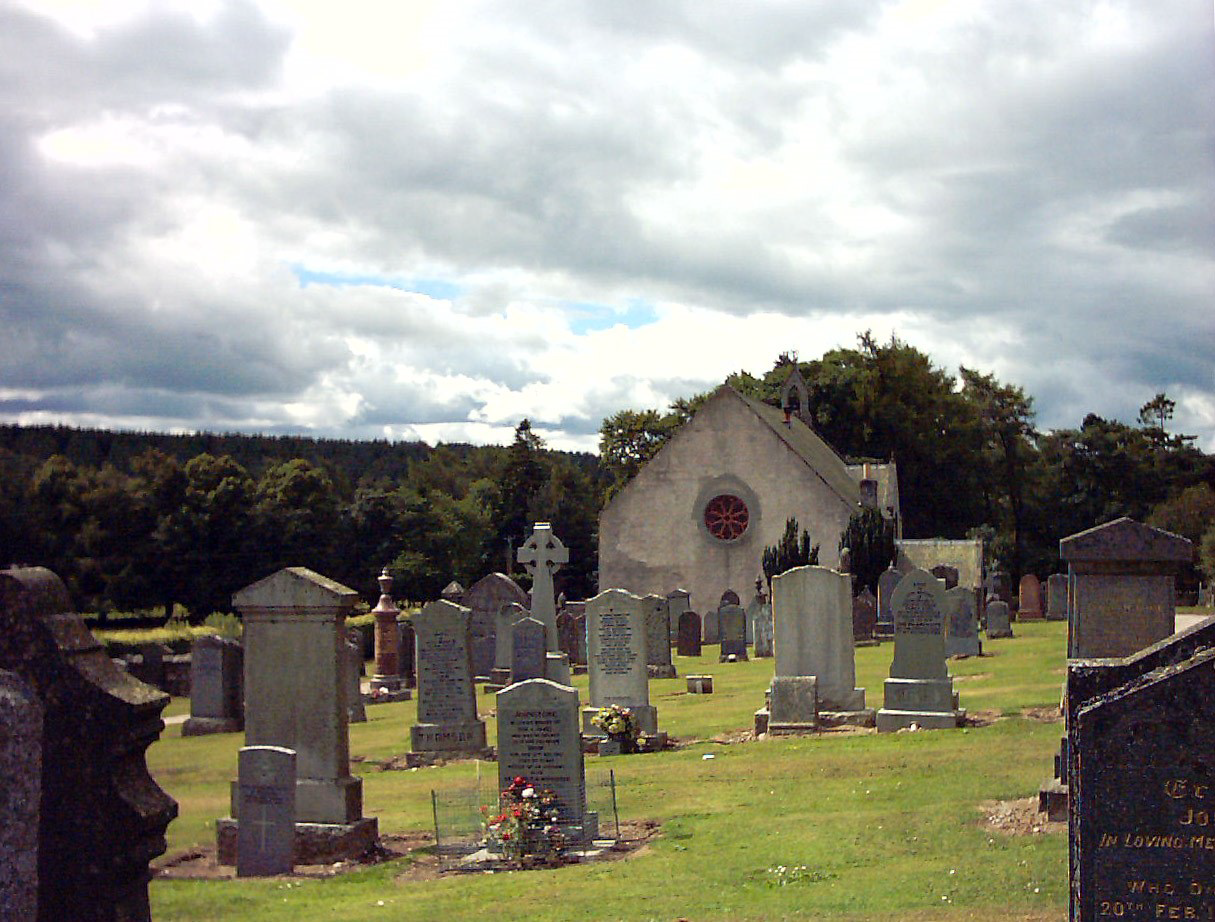
Cover Photograph by Gavin Bell