Publication Info
Publication Details
Introduction
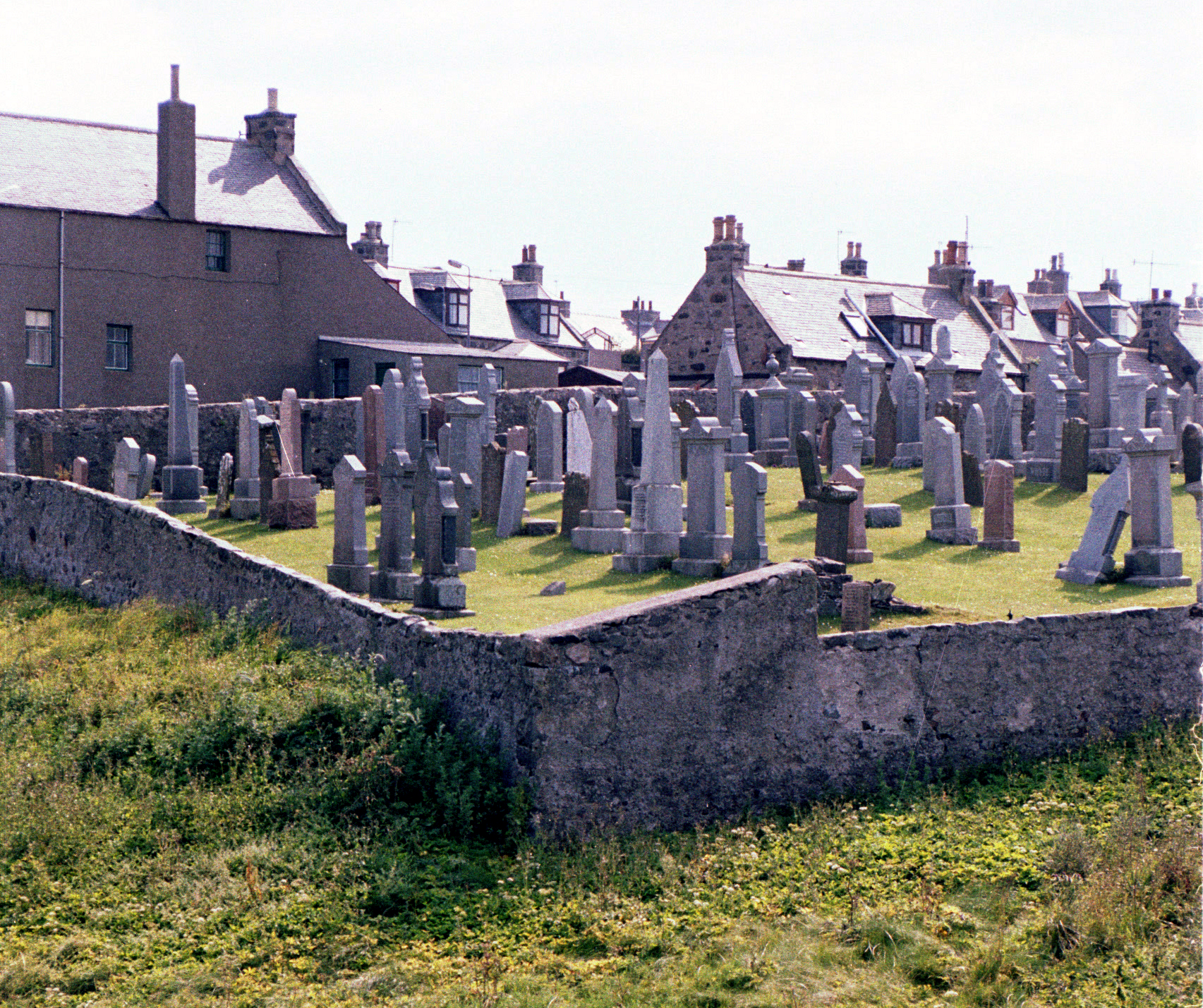
The ancient kirkyard of St Combs, formerly St. Colm’s, sits on a bent-covered knoll about 150 yards from the sea shore. Little now remains of the kirk itself. Dedicated to St. Columba, it predates the Reformation and was abandoned in 1607. However, the men of the twin villages of Cairnbulg and Inverallochy continued to bury their dead in the kirkyard up until the early 1930s when the Cairnbulg-Inverallochy burial ground (off the B9033 road east of Fraserburgh) opened. Even after this there was the occasional burial, the last one being in 1960. Villagers of St. Combs are also buried in the kirkyard, but are more likely to be found in one of the three Lonmay graveyards 2 miles inland, the oldest of which was built following the closing of the old St. Combs kirk. That the villagers of Cairnbulg and Inverallochy buried their dead in St. Combs, parish of Lonmay, is something of an anomaly, since the twin villages are within the parish of Rathen, directly north of Lonmay. The village of St. Combs is a much more modern community than Cairnbulg and Inverallochy, however, dating back only to the mid 1700s, and the kirk of St. Colm’s probably stood alone in the sand dunes for centuries. The Rathen men had a long established custom of digging the graves of their dead without official intervention, and only during the 1849 cholera epidemic was their right to do so challenged. Concerned about the possible spread of infection from the funeral processions from the twin villages passing through St. Combs, the Lonmay Parochial Council established certain regulations, one being the appointment of an official gravedigger. More formal records of burials began to be kept, and there exists a Lair Book detailing the occupants of each lair from the 1850s onward. The Lair Book also identifies two specific areas within the kirkyard: the Strangers Ground and the Church Lines. The former was originally where non-locals were buried, such as the unidentified bodies of seamen washed up on shore. Here also are interred the bodies of upwards of 50 villagers who succumbed to cholera in 1849. In the early 20th century the Strangers Ground was increasingly used for the burial of local folk, presumably for space reasons. The 6 Church Lines include the graves located within the original boundaries of the kirk walls, although there is little significance to this demarcation since even the earliest gravestone postdates the abandonment of the kirk by at least a century and a half. The modern St. Combs Kirkyard is approximately rectangular in shape, being about 125 feet in breadth by 116 feet in length. There are 14 lines of graves, with up to 39 lairs in each. According to Pratt’s “Buchan” (Revised edition, p. 223; cited in Henderson: “Aberdeenshire Epitaphs and Inscriptions”) the outside dimensions of the church were 21 feet by 60 feet, with walls 27 inches thick. The Church Lines cover about 20 feet by 50 feet, indicating that the original building must have extended past these towards the east (seaward) wall of the modern graveyard. This MI compilation is the culmination of work by several independent groups. The earliest was a draft prepared by unidentified ANESFHS members dating back to the 1960s or possibly even earlier. Although incomplete and unorganized, this had the advantage of including MIs that are no longer readable. Two transcripts unreadable even at the time of the ANESFHS work were obtained from Henderson’s book (gravestones 65 and 78). Following preparation of our first complete transcript, we were made aware of an independent one recently completed by Ken Pickering of Charleston, St. Combs. Ken’s work allowed us to identify some errors in our own work, for which we are grateful. The current booklet is the precursor of what will be a more extensive documentation of the occupants of the St. Combs Kirkyard. This compilation has taken previous ones a step further by having had many of the MIs checked against the official death records of the General Register of Scotland (GROS). For future publication, we have completely transcribed the lair records, and have correlated these with the gravestone MIs. Since lairs in St. Combs Kirkyard containing a dozen or more occupants are quite common, the lair records expand the information available from MI transcriptions considerably. Each stone has been photographed, and we are in the process of compiling all this in digital form. Linkages to transcriptions of GROS death registrations and photographs of the original lair book pages will complete the project. During our photography sessions in the kirkyard we became aware of a number of flat stones completely covered over by turf. By peeling back (and carefully replacing) the turf from several of these we were able to confirm their identity with the help of the ANESFHS draft transcript. Since some of the inscriptions had deteriorated since the original transcript was made, we have mostly used the latter in the present compilation. Wherever we have used ANESFHS transcripts in the booklet, or transcripts from Henderson, the sources have been identified. Some MI transcriptions have notations in square brackets. These provide additional information such as dates missing from damaged/eroded stones. In some cases inscribed information is inconsistent with official records, and the notations bring attention to these inconsistencies. For example, the birth year of William Stephen inscribed on gravestone 97 is clearly “1860” but from GROS, son William Stephen was born 1869. Also, the inscription notes he was lost at sea in 1902 aged 33 years; i.e., he was born around 1869. The inscribed date is therefore incorrect. Another example is found on gravestones 8 and 9. Both contain the inscription “also his daughter Jessie who died 17th November 1879, aged 17 years”. Since Jessie cannot have had two sets of parents, one inscription must be incorrect. Death records confirm her parentage as detailed on gravestone 9. Did the stonemason make a mistake – inscribing the information on gravestone 8 and having to redo it on number 9? These examples provide a caution that MI inscriptions are not always accurate, and may require further study. Often, the gravestones were erected, or inscriptions added, decades after the event, and memories may have become clouded. Almost all the notations have been made after careful checking against the original GROS death records. Our thanks go to all involved in the preparation of this booklet and especially to Gavin Bell for his meticulous editing. Jim Campbell Jim McNab