Publication Info
Publication Details
Introduction
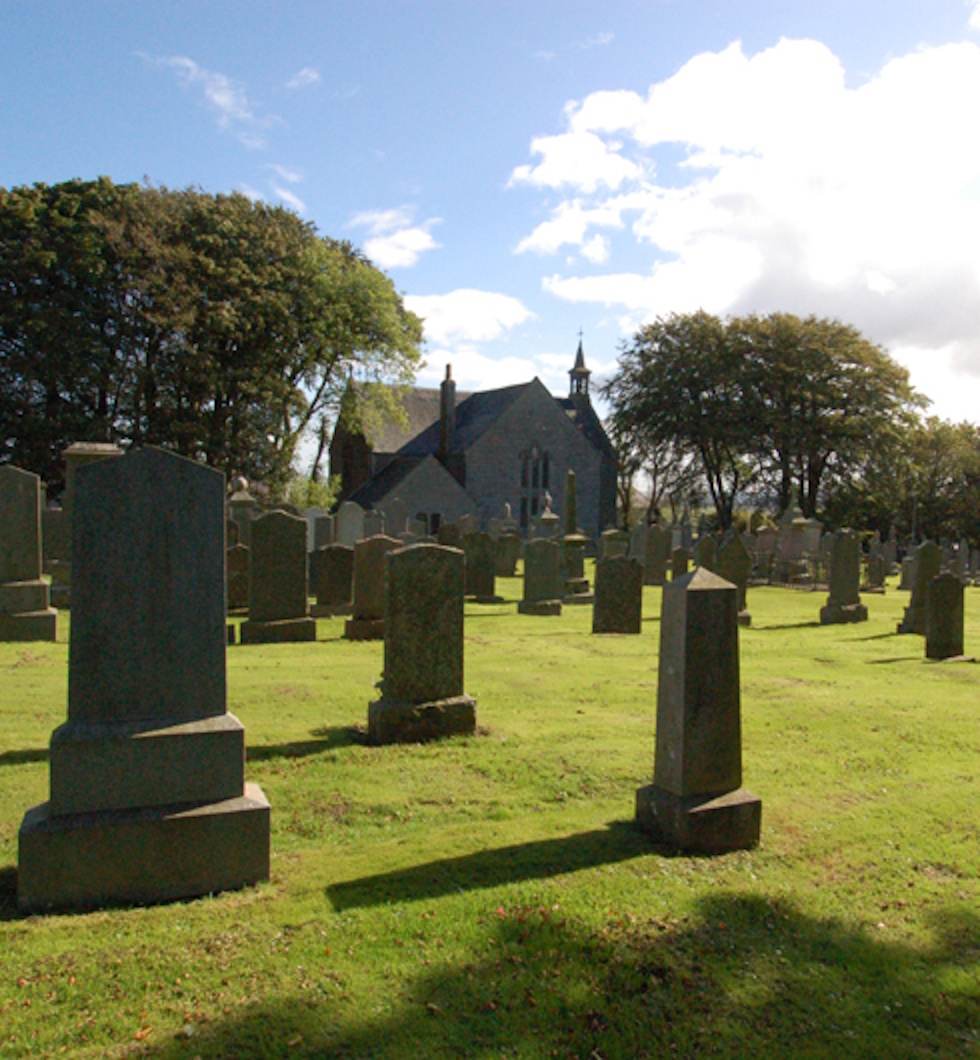
As one of the rash of “new” towns and villages which were established in Scotland in the late 18th and early 19th centuries by landowners seeking to encourage trade and commerce, New Pitsligo was founded in 1787 by Sir William Forbes of Pitsligo. But to the continuing confusion of genealogists, Sir William owned no suitable site in his home parish of Pitsligo, and instead planted his new settlement in the south of the parish of Tyrie. The church was built in 1798, and the burial ground seems to have come into use a few years thereafter – although to continue the theme of confusing names, both are commonly referred to as “Turlundie”, from the name of the hill on whose slopes they lie. The establishment of a church in the south of the parish was a great convenience to many inhabitants of Tyrie, because the parish church (MIs published by ANESFHS as AA190) lies at the extreme northern end of the parish. For similar reasons of remoteness from their own parish kirks, residents of the adjacent parts of the neighbouring parishes of Aberdour, New Deer and Strichen started using the church and burial ground in New Pitsligo, and this situation was formally recognised in 1853, when New Pitsligo was erected into a quoad sacra parish in its own right, incorporating parts of those parishes. A further oddity caused by New Pitsligo’s status as a deliberate plantation is the frequency with which its residents are described on their gravestones as “feuar”. One of the initial inducements offered by Sir William Forbes was the opportunity for settlers to purchase building plots, at a time when the great majority of people did not own their own houses or land. Under the Scottish system of land tenure, which was derived from the mediaeval feudal system, “feuar” is the term used to refer to the owner of such a plot, and was taken by many of the residents of New Pitsligo as a badge of honour. The kirkyard was visited by John A. Henderson, and is included in his “Aberdeenshire Epitaphs and Inscriptions” (1907), although, as ever, he recorded only a handful of stones which caught his interest. Most can still be identified, but two inscriptions which cannot now be found are included in the Appendix to this booklet. In times past, at least two different individuals or groups of ANESFHS members appear to have started out on recording the Memorial Inscriptions of New Pitsligo, but the resultant drafts covered at most a quarter of the stones in the kirkyard. The immediate impulse for completing the task was an enquiry from the Landscape Services Department of Aberdeenshire Council. As the section responsible for the upkeep of burial grounds, they often receive enquiries about lair records, but as the records for the original part of New Pitsligo do not appear to have survived, they wondered whether ANESFHS had recorded the MIs. On learning that Landscape Services were about to carry out an electronic survey which would result in an accurate plan of the kirkyard, and that they were prepared to share this with us, the decision was made to start the work. Our thanks go to Ian Tillett who first set this hare running, and to Joanne Davidson who carried out the survey. Following our earlier experiments at Echt New Kirkyard (MIs published as AA170), it was decided to tackle New Pitsligo with a combination of traditional and hi-tech methods. A select band of seasoned “graveyarders” spent an initial day on-site checking the inscriptions recorded in the earlier drafts, and recording some additional inscriptions. At the same time, digital images were made of the remainder of the unread stones, and the images sent to volunteers for transcription. As ever, some stones proved unsuitable for this treatment, and required further visits on-site, as did the process of checking. My thanks go to all who participated, in whatever capacity – but as co-ordinator, editor and checker-in-chief, I bear responsibility for any remaining errors. Gavin Bell
Comments
New Pitsligo New Kirkyard, also known as 'Turlundie' (parish of Tyrie), naming 1526 individuals between 1811 and 2003