Burial Site Info
Fordyce Old Cemetery
Fordyce, BanffshireAddress: Fordyce Old Cemetery, Bridge Street, Fordyce, Aberdeenshire, AB45 2SN
Site Type:
Kirkyard

Latitude: 57.662350
Longitude: -2.746337
Find A Grave Link: https://www.findagrave.com/cemetery/2587875/fordyce---st-talorgan-old-graveyard463 memorials
Website: -
Description: Being both historic and picturesque, the kirkyard of Fordyce and its memorial inscriptions have long attracted the attentions of antiquarians and genealogists. One of the earliest was Andrew Jervise, who in 1879 published transcriptions of around 30 stones, although, as ever, he appears to have concentrated on the stones of what he regarded as “important” people.
Then, in 1886, William Cramond, that industrious chronicler of Banffshire, recorded transcriptions of over 200 stones. Unlike Jervise and most other 19th-century antiquarians, he did not cherry-pick the monuments of “the Great and the Good”, but appears to have recorded every inscription which he could find. Our only quarrel with him is that, while he numbered most of the stones in a fairly consistent sequence, he does not appear to have made a numbered plan.
With the rise of interest in genealogy in the later 20th century, two further sets of transcriptions appeared. Exactly a century after Cramond, Alan Davidson, a resident of Fordyce and an early member of ANESFHS, produced an updated version of the MIs, running to just over 300 stones, and including a rough sketch plan of the burial ground. There also emerged, seemingly around the same time, another version of the MIs, credited to a “Mr Green” who we have not been able to identify. This contained slightly fewer stones than the Davidson version, with a similar (but not identical) sketch plan, and a significantly different numbering system.
In an effort to make sense of this incipient Tower of Babel, a joint team from ANESFHS and the Portsoy Salmon Bothy re-surveyed the kirkyard, starting in 2015, to produce a more accurate plan of all the visible stones, and then re-read the inscriptions on those stones. It immediately became obvious that Jervise and Cramond had seen wording (and entire stones) which are no longer visible, while even Davidson and Green may have seen details which are now lost. And, at a relatively late stage in the proceedings, a warm dry spell suggested the presence of a number of stones buried beneath the turf.
In order to reconcile the various versions and provide a maximum of reliable information, the inscriptions are reported as follows:
All stones which are currently visible and at least partly readable are given a plain numeric number and appear with this number in the main MI table and on the kirkyard plan. Where inscriptions have deteriorated, the text may be supplemented by data from Cramond or one of the other surveys.
Stones recorded by Cramond, but no longer visible, are given a number preceded by “C” and appear in the secondary MI table.
Where we are confident that we can identify the location of a buried “Cramond” stone, it will be shown on the plan with a dotted outline and its “Cnnn” number, and it will appear in the table with an asterisk beside the number.
The small number of buried stones which we could not reliably link to one of Cramond’s transcriptions appear on the plan with a dotted outline and labelled “?”
Inscription Status
Maps
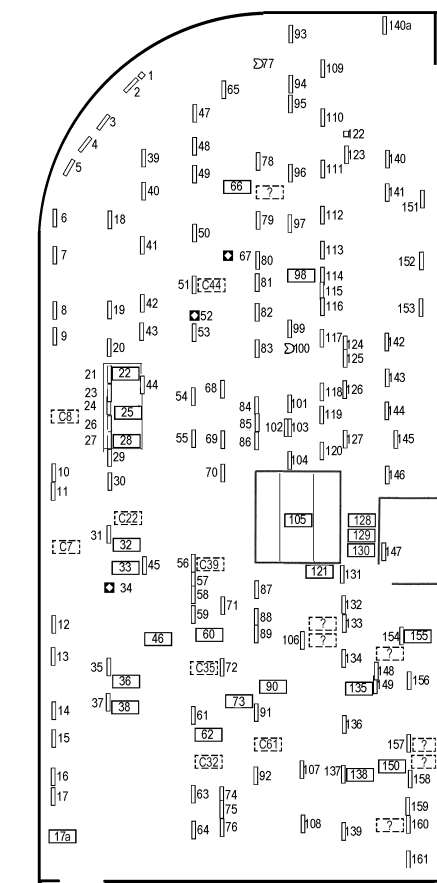
Fordyce Kirkyard 1
1 of 2Publications
| Code | Title |
|---|---|
| AA076 | The Kirkyard of Fordyce |